THE COMFORT ZONE OF LEARNING
THE COMFORT ZONE OF LEARNING
Learning happens when our brains feel safe and comfortable Some theories purport that learning is gaining new knowledge that wasn’t there yet, and in a way it is, but learning is actually a function of adding knowledge to what is already there.
Learning is like building. We add brick by brick, brick on top of brick, to the foundation that already exists. A baby can learn to walk once it has learnt how to move its limbs and control them. A baby cannot learn to fly as it doesn’t have the basic foundation or equipment to master that skill.
Neurologically we grow in the areas of our greatest abilities. We know that, according to research and science, our brain grows more where it’s strongest. Our brains grow more neurons and synaptic connections where there are already a lot of neurons and synaptic connections.
You know what you know, and you know what you don’t know, but focusing on your shortcomings doesn’t enable learning, it actually impairs it. Learning and adding to our knowledge excites our brains. We gain confidence as we grow our knowledge. The more we know, the more we want to know.
It’s like teaching a child to tie their own laces. You don’t just hand a toddler a pair of shoes and say, “here you go, put them on and tie the laces,” you break it down into manageable chunks. First you teach them to put on their socks, then the shoes, then how to tie the first part, then the second. It is a progression of steps, a mastery of confidently constructing a skill. Brick by brick.
What happens during this process is positive for our brains. Learning happens when we see how we can improve or increase our knowledge. It relies on our understanding of what we are doing well, on what we know we know. It does not rely on what we don’t know, or what we are not doing well.
When we are stressed because we are paying attention to what we can’t do or don’t know, our sympathetic nervous system is activated, and our ‘fight or flight’ response kicks in. This means our brains shut down unnecessary processes and only focus on what is critical for survival. This creates a negative cycle which inhibits learning because it inhibits access to existing neural circuits and causes cognitive, emotional, and perceptual impairment. Focusing on inadequacies hinders learning. It is like a baby trying to learn to fly when the basics aren’t there to enable that.
Fortunately, the opposite is also true – when we focus on the positive, what we know and what we know we can improve and learn more about, our parasympathetic nervous system is activated. Neurogenesis (growth of neurons and new neural pathways) is stimulated and our brains are more receptive to learning and perceptual openness.
We learn best and most in areas where we feel comfortable because that is where our neurons are more concentrated, and where we feel more open to possibilities, creativity, and increasing our learning.
What does this mean for education?
Improvement and learning cannot be happen by studying failure. When we point out what a learner got wrong, such as a spelling mistake, we may get a correctly spelt piece of writing, but we aren’t going to get their best piece of writing. The anxiety that surfaces around getting it ‘right’, obstructs the creative flow that may have allowed them to get it ‘excellent’.
We have to remember in order for true learning to take place, we need to know what we know, and build brick by brick, in a comfortable environment where foundations are recognised, anchored, built upon, recreated and improved.
That is learning. And that only happens when our brains feel safe.
What is the goal of education anyway?
What is the goal of education anyway?

We know the world is changing. We know the industrial model of education that has been around for about two hundred years no longer makes the grade when it comes to educating children. Education is no longer simply about teaching children to read, write and do ’rithmetic. In this era of massive and rapid changes in environmental, political, cultural, technological, and economic change, the way we educate children has to shift too.
My niece just started Grade One and I was once again struck by how much potential lies ahead. She is like a brand-new sponge, eager to absorb as much new learning and information as she can. Grade Ones arrive so excited and enthusiastic about school. They want to learn. And yet, all too soon, that enthusiasm is squished because their natural inclination to innovate and create is stifled by binary right and wrong answers, red pen crosses, and standardised moulds that they are meant to jam themselves into to be the “this-is-what-a-good-student-looks-like” fit.
Education needs to change. We need an approach to education that encourages innovation if we are going to produce people equipped to solve the new problems that are cropping up all the time. For us to foster children who are creative problem solvers, we need to encourage curiosity, innovation, resilience, agility, and imagination. The traditional education model does none of those things.
Totally changing the education system may seem a bit revolutionary, but the truth is we don’t have to completely disregard the previous way of educating. We just need to change it into a way that takes what did/does work, and adapts it into a new kind of education. An education that can cope with and prepare our youth for the rapidly changing, unpredictably unsettled world that now exists.
Education can no longer be thought of as linear or binary. The world is no longer organised, systematic, or predictable. There are many ways to reach destinations and as such our education system needs to be an open system – open to multiple solutions; open to multiple pathways; open to multiple modes of educating; open to multiples ways of learning; open to multiple types of learners and intelligences.
Students currently make up 20% of the population, but they are 100% of our future. And if we are to save the future, and our planet, then we need goodwill between nations and people because only that is going to save this generation from wars, revolutions, and planetary depletion. Education is the key!
Without the foundation of goodwill and social responsibility as the core of society, we will not be able to solve the world’s problems or save the planet. And honestly, what is more important than that?
In many countries education remains a political agenda, but we need to move away from the politics and face the fact that GOOD education needs to become an elegant engine of change. It really is so simple, and yet we can’t seem to get it right. The nucleus of saving the world lies in educating at individual and community levels. Education needs to be the force that unites people and nations and cultures for a sustainable, peaceful world.
The way we educate and the type of student we churn out of the system needs to be prepared for the likes of Corona Virus pandemics, and other disasters that may rear their ugly heads. The students need to be educated in ways that prepare them for the unpredictable. They need to love learning, they need to be engaged, they need to be emotionally intelligent and resilient, they need to prioritise mental health and understand the value and importance of collaboration.
A child who is only educated academically is an uneducated child. The goal of education then, should be to ensure the survival of our species and the planet, and it needs to do that by nurturing a love for learning, a persistent curiosity, tenacity and resilience, a sense of community and above all that, compassion.
If that isn’t the goal, then what is the point?
Baby Steps into 2023
Baby Steps into 2023
New year’s resolutions… pah. Not a fan. But I went back to work yesterday, and I can’t help but feel a certain kind of freshness and resolve that comes with a brand-new wall calendar, a clean notebook, a new TO DO list, and an empty desk pad.
It smacks of promise and a fresh, clean beginning. It is inspiring to know that you have a blank year ahead and you can create and do with it what you want. I feel very energized and inspired and hopeful.
Don’t get me wrong, it’s not like my challenges vanished with some magical pop of champagne at midnight on New Year’s Eve, but somehow the cobwebs have cleared and my resolve to tackle the year is stronger. More energetic. I guess a bit of down time and time spent with people who make us happy is restorative like that.
Instead of setting new year’s resolutions, which tend to be forgotten by the time January 31st rolls around, I think we should take baby steps into 2023. Small, actionably steps that are achievable. If you want to make a million rand this year, putting that on paper or a dream board is quite a big goal. But if you break it into smaller actionable steps, focusing on the things you can do daily to achieve that, it becomes easier.
Think about dieting. Losing weight is probably one of the most common New Year’s Resolutions. When we start with “I need to lose 10kgs this year” that can seem overwhelming. But if we say, right, to lose 10kgs, there are baby steps I can take, daily actionable steps, to make that happen. Things like getting up 15mins earlier a day to make time for one baby step – be it 15mins of exercise, or a glass of hot lemon water, or time to pack a healthy lunch. That seems achievable. And if you add up the cumulative effect of those baby steps and focus on those, before you know it, you are on your way to that goal without feeling the enormity of it.
The other upside to taking baby steps is you can enjoy the journey and aren’t continually waiting for that holy grail to be reached before you can feel happy. Until you feel you have achieved something worthwhile. When we set goals that are far off, there’s a mental process that makes us feel we can’t be happy until we reach them. Either we succeed or we fail. And unfortunately, this is probably why we fail. Waiting to be happy becomes tedious and sucks the joy right out of everything and it feels like a mammoth task that we slowly lose enthusiasm for attaining.
So, this year, instead of making massive New Year New You type resolutions, make New Year, Better Me baby steps.
If I had to say what my main resolution was, I would say it is to eliminate things that don’t directly feed what I really want for this year and for my life. Again, that sounds big. I am terrible at saying no so even thinking about it gives me a guilty anxiety. But! At the end of last year, I was completely overwhelmed and so thinly stretched that I was feeling it physically and honestly if you had said BOO to me, I would have promptly burst into tears because my nerves were so frayed. The baby step for me is to start saying no to things that aren’t aligned to my wellness – mentally, physically, and financially. I am proud to say that I have resigned off a functions committee at my son’s school which took up so much of my time! And I have graciously opted out of writing (for free) for other publications. I have decided to draw boundaries and so far, so good. Granted, it’s only the 11th of January, but baby steps. And so far, I feel quite good about the boundaries and what’s more, the world hasn’t ended because I said no. 😊
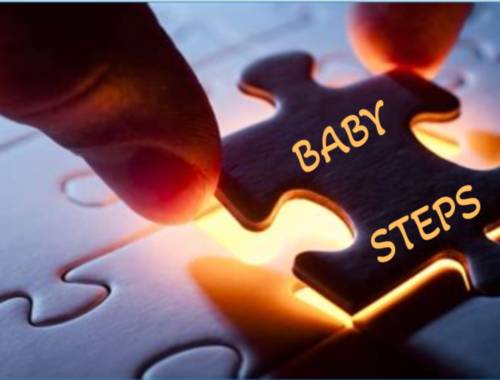
You don’t decide to just get a 2000-piece puzzle done as you tip out the box. You do it one piece at a time. Initially it’s a broken frame, then a whole frame, then a few random clusters of joined pieces, and then it starts to come together. One baby step at a time.
So, as you step into 2023, take baby steps. Don’t try eating the whole elephant in one go. Small bites, baby steps, focus on the immediate actionable steps you can take, and do those, and before you know it, the bigger picture will take care of itself.
Happy New Year! Happy baby stepping!
Natalee x


Shaping Future Leaders